Author

admin

Browsing

A federal judge on Monday agreed to permanently block the release of volume two of former special counsel Jack Smith’s report — centered on President Donald Trump’s handling of classified materials after his first term in office — in a significant victory for the president and his co-defendants.

U.S. District Judge Aileen Cannon, a Trump appointee, granted the president’s request to permanently block the release of the second volume of the report, ruling that its publication would represent a ‘manifest injustice’ both to Trump and the co-defendants in the classified documents case.

‘Special Counsel Smith, acting without lawful authority, obtained an indictment in this action and initiated proceedings that resulted in a final order of dismissal of all charges,’ Cannon said Monday. 

The ruling blocks the Justice Department from ‘releasing, distributing, conveying, or sharing with anyone outside the Department of Justice any information or conclusions in Volume II or in drafts thereof.’ 

Cannon previously ruled that Smith was unconstitutionally appointed as special counsel, though the matter was ultimately dismissed following Trump’s re-election in 2024.

Smith was tapped by former Attorney General Merrick Garland in 2022 to investigate the alleged effort by Trump and his allies to overturn the results of the 2020 election, as well as Trump’s retention of allegedly classified documents at his Mar-a-Lago residence in Palm Beach after leaving office in 2021.

Smith had brought charges against Trump in both cases.

The charges were dropped after Trump’s election, in keeping with a long-standing Justice Department policy that discourages prosecuting sitting presidents on federal criminal charges. Smith resigned from his role shortly afterward.

This is a breaking news story. Check back for updates.

This post appeared first on FOX NEWS

Four soccer matches in Mexico have been postponed in the wake of the death of a powerful drug cartel leader near Guadalajara, one of the host cities for the 2026 World Cup this summer.

Mexican drug kingpin Nemesio Oseguera, who’s known as ‘El Mencho,’ died Sunday, Feb. 22, from injuries suffered in a shootout with Mexican officials that also killed six other cartel members.

The resulting civil unrest forced soccer officials in Mexico to postpone two top-tier matches indefinitely − Queretaro vs. Juarez FC in the men’s league and Chivas vs. America in the women’s league − and call off a pair of second-division matches.

After reports of El Mencho’s death, suspected cartel members blockaded highways with burning cars and torched businesses in more than half a dozen states. 

The Mexican national team has a friendly scheduled against Iceland on Wednesday, Feb. 25, at the Corregidora Stadium in Queretaro. The status of that game is still in limbo.

Meanwhile, organizers of the Mexican Open men’s tennis tournament in Acapulco said the event would begin Monday as scheduled under established security protocols.

Guadalajara is scheduled to host four World Cup matches in June, including two involving South Korea. Co-host Mexico, Spain, Uruguay and Colombia will also play there.

This post appeared first on USA TODAY

When Team USA general manager Bill Guerin named the U.S. Olympic men’s ice hockey team on Jan. 2, the second guessing began.

It was mostly the 4 Nations Face-Off team, which was impressive but lost to Canada in the final. There were a few others, such as Quinn Hughes, who had been named to last year’s team but couldn’t go because of an injury.

Tage Thompson was a welcome addition, as was Clayton Keller. But why were big-time scorers Cole Caufield, Jason Robertson and Lane Hutson left off while J.T. Miller and Vincent Trocheck of the struggling New York Rangers were brought back?

Guerin said he was building a hockey team, not an All-Star team.

Well, he was right. The United States won its first gold medal since 1980, beating Canada 2-1 in overtime, completing an impressive year for USA Hockey’s top national teams. There was a women’s hockey gold, also against Canada, a men’s and women’s world championship and a sweep of the women’s Rivalry Series.

Here are the winners and losers of the men’s hockey tournament at the 2026 Winter Olympics:

WINNERS

Jack Hughes, USA

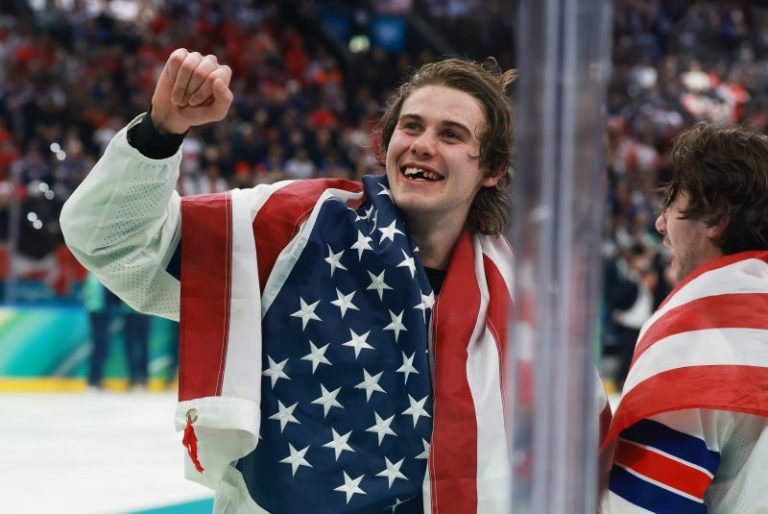
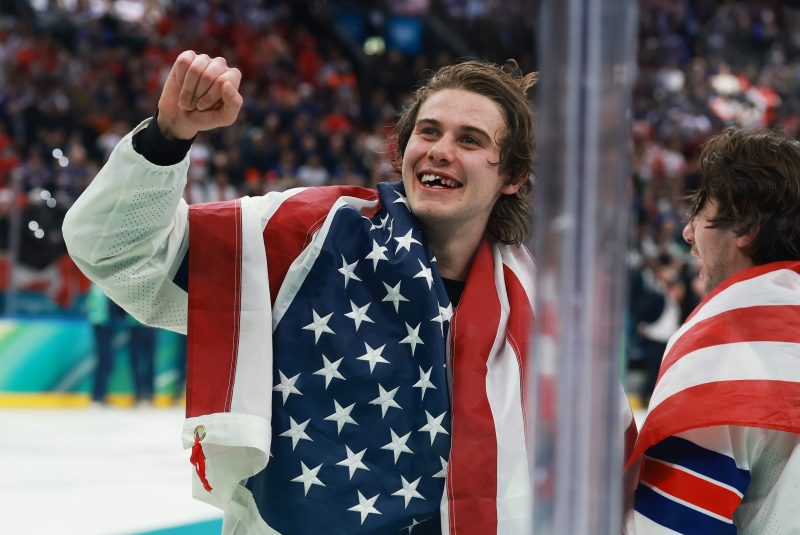
The Devils star had to overcome so much to play in the Olympics. He rehabbed from last year’s season-ending shoulder surgery, had a freak accident at a team dinner that required finger surgery and also missed games leading into the Olympics. He joined brother Quinn in Milan, made sweet passes in the Latvia win, scored twice against Slovakia and had the golden goal against Canada. Naturally, he did it after an injury, getting high sticked and losing a tooth in the third period.

Auston Matthews, USA

The inability of the Toronto Maple Leafs to get far in the playoffs has led the city’s tough hockey media to question the team’s stars, including captain Matthews. Well, Matthews was named the USA’s captain, just as in the 4 Nations, and he now can respond that he can lead a team to victory.

Connor Hellebuyck, USA

Last year, he won the Vezina Trophy and got a rare goalie Hart Trophy win. But he was pulled in three games on the road against the St. Louis Blues in the playoffs. Can’t win a big game? Well, the USA doesn’t win on Sunday without Hellebuyck, who made 41 saves.

Sending NHL players to the Olympics

The hockey was great, especially in the quarterfinals, when three games went to overtime. But the best was the gold medal game. Canada pressed and looked like it was going to rally and win for the third game in a row. But the USA eventually prevailed against a heated rival. Best on best is the best way to do the Olympics.

WINNER AND LOSER

Connor McDavid, Canada

The 4 Nations overtime goal scorer had an impressive tournament and was named MVP after scoring 13 points, a record by an NHL player at the Olympics. But the award was bittersweet because Canada won silver, not gold. It’s the second time he was given an individual prize when his team came in second. He was voted the Conn Smythe Trophy as playoff MVP in 2024 after the Edmonton Oilers lost Game 7 of the Stanley Cup Final to the Florida Panthers.

LOSERS

Sidney Crosby missing the final

When the Canada-USA game went to overtime, it brought back memories of Sidney Crosby’s golden goal in 2010. No chance of that, though. The Canadian captain was injured in the quarterfinals, when he was hit hard twice. He missed the semifinals and couldn’t make the final and try to win his third gold medal. And now the Pittsburgh Penguins will have to figure out if he’ll miss part of the stretch run.

Los Angeles Kings

They made the big trade for Artemi Panarin and were looking for him to boost their offense enough to get back in the playoff hunt. But now they suffered a setback because Kevin Fiala broke his leg in a loss to Canada, had surgery and will miss the rest of the regular season. NHL owners are concerned about players getting hurt at the Olympics and it happened in varying degrees to Fiala, Crosby, Josh Morrissey and Mikko Rantanen.

Pierre Crinon, France

He delivered a questionable hit on Nathan MacKinnon, leading to a scrap with Tom Wilson. The International Ice Hockey Federation prohibits fighting and could have suspended him, but it didn’t. The French team did, though, saying: ‘Pierre Crinon’s provocative behavior when he came out of the ice, even though he had just been excluded from the match for a fight, is a clear violation of the Olympic spirit and also undermines the values of our sport.’

3-on-3 overtime

There were four overtimes in the knockout round and theoretically, they could have lasted 10 minutes, and 20 minutes or longer in the gold medal game. But the longest overtime was 3 minutes, 27 seconds. That’s because of 3-on-3 play in overtime. The NHL uses it in the regular season but switches to 5-on-5 in the postseason. That’s because it knows a crucial game shouldn’t be decided by something gimmicky. The IIHF should rethink its position for the 2030 Olympics.

This post appeared first on USA TODAY

Kara Braxton, a former WNBA All-Star who played 10 years in the league, has died, the league announced on social media. The cause of death was not given. She was 43.

‘It is with profound sadness that we mourn the passing of 2x WNBA Champion Kara Braxton. A 10-season veteran, Kara played with the Detroit Shock, Tulsa Shock, Phoenix Mercury, and New York Liberty. Our thoughts are with her family, friends, and former teammates at this time,’ the WNBA shared on X.

Braxton was drafted No. 7 overall in the 2005 WNBA Draft by the Detroit Shock. She was named to the WNBA All-Rookie team after averaging 6.9 points and 3.0 rebounds. A 6-foot-6 power forward, she would go on to win championships in 2006 and ’08 with Detroit.

She played in Tulsa, when the Shock relocated, and also spent time with the Phoenix Mercury and New York Liberty. Braxton also played overseas in Poland, Turkey, China and Italy through the 2017-18 season.

Born in Jackson, Michigan, on Feb. 18, 1983, Braxton attended high school there her freshman year before transferring to Westview High School in Portland, Oregon. She was named Oregon Gatorade Player of the Year as a senior. She played college basketball at Georgia for two-and-a-half seasons before being dismissed from the team by then-coach Andy Landers for undisclosed reasons.

Braxton worked for Nike in Oregon after her retirement from professional basketball before moving to the Atlanta area. Her son, Jelani Thurman, was on the 2024 Ohio State national championship football team. He played tight end.

Braxton is survived by her husband, Jarvis Jackson, and her two sons, Thurman and Jream Jackson.

This post appeared first on USA TODAY

With crucial friendlies against Belgium and Portugal coming up next month, several key U.S. men’s national team players are trending toward making the roster with no injury concerns.

There was positive injury news for three players who are set to play a vital role at the World Cup this summer, as Ricardo Pepi, Tyler Adams and Christian Pulisic all took steps forward over the weekend.

That trio’s return to health leads off this week’s Five.

Ricardo Pepi back with a bang

Ricardo Pepi was back ahead of schedule from a broken arm on Saturday, Feb. 21, and the PSV striker picked up exactly where he left off.

Pepi found the net with a brilliant long-range strike only minutes after coming on against Heerenveen, providing the insurance goal in a 3-1 win for PSV.

The striker had scored in five consecutive league matches when he suffered a broken arm on Jan. 10, which PSV said would keep him out for two months.

But Pepi returned a couple weeks early, which PSV coach Peter Bosz attributed to his strong mentality.

‘I believe that if you have a positive mindset, that contributes to your healing,’ Bosz said ahead of the game. ‘Ricardo Pepi when I was with him in the hospital was all about getting back on the field as soon as possible. He wanted to play football again. I think that helped him in particular.’

Tyler Adams back in the mix

Pepi wasn’t the only key USMNT player back on the pitch over the weekend, as Tyler Adams made his first appearance for Bournemouth since December in Saturday’s 0-0 draw with West Ham.

Adams started and went 66 minutes, putting in his usual strong defensive work in midfield with three duels won, five clearances, two tackles and five defensive recoveries.

The 27-year-old suffered an MCL sprain on Dec. 15 that Bournemouth said would sideline him for 2-3 months.

Adams wasn’t ahead of schedule like Pepi, but came in right at the two-month mark. That will give him plenty of time to get back in the swing of things before the USMNT’s March friendlies.

Christian Pulisic looks healthy in frustrating loss

Sunday may have been the death knell for AC Milan’s title hopes, but it also had some positive individual news for Christian Pulisic.

Pulisic started his first game in a month for Milan, which saw a 24-match unbeaten run snapped with a shocking 1-0 home loss to Parma.

With 10 points between them and first-place Inter, the Rossoneri may have to settle for a Champions League berth in what has still been a solid bounce-back campaign.

After dealing with bursitis over the past month, Pulisic was active in his return to the lineup. The 27-year-old had three shots on target and two chances created, and may have had multiple goal contributions on a different day.

The key for Pulisic now will be to stack a few starts together as he still chases his first goal contribution of 2026.

Folarin Balogun bounces back

We highlighted Folarin Balogun last week after he extended a lengthy dry spell with Monaco.

Balogun had gone 11 of 12 games scoreless before a week where he was at his deadly best against the two top teams in France right now.

First there was a midweek double against Paris Saint-Germain in the Champions League, giving Monaco an early two-goal advantage it could not maintain in an eventual 3-2 defeat.

Just a few days later in Ligue 1, Monaco pulled off the exact reverse feat against first-place Lens. After going down two goals, Balogun scored to spark a furious second-half comeback that culminated in a 3-2 victory for the principality side.

Balogun’s goal output has been augmented – or limited, depending on your perspective – by his streakiness. After another long drought, the 24-year-old will hope the floodgates are now open.

Brenden Aaronson returns to earth

Brenden Aaronson was named Leeds Player of the Month for January, but there probably won’t be an encore this month.

Aaronson took his usual place in Leeds’ starting lineup against Aston Villa on Saturday, but couldn’t get much going before he was removed in the 73rd minute of a 1-1 draw.

The game at Villa Park marked the seventh in a row without a goal contribution for Aaronson, who scored three goals in January.

Aaronson has still had an excellent bounce-back campaign overall for Leeds, tallying four goals and three assists while contributing his usual strong link-up play and defensive work.

But if there was any notion that the goals and assists would start flowing after his prolific spell in December and January, the last month has dispelled that idea.

This post appeared first on USA TODAY

The race to the moon is on — again. But the strategic competition playing out today is much bigger than our race with the Soviet Union in 1969. If China reaches the moon ahead of the United States and establishes a permanent, manned presence — it will not treat the lunar surface as a peaceful scientific outpost, but as an extension of its campaign to surpass America, intimidate our allies and compromise our systems that keep the American homeland secure. This is no longer something of science fiction.

President Donald Trump understands this threat, signing the Executive Order on Ensuring American Space Superiority, which made it abundantly clear that he wants the United States to lead this new space race — returning Americans back to the moon by 2028 and building a permanent manned presence on the lunar surface.

Let me be clear, the fear that China could somehow ‘claim’ the moon by arriving first misunderstands both geography and international reality. Two of the main locations for settlement are the Shackleton Crater, which stretches about the distance from Washington, D.C., to Baltimore, Maryland, and the South Pole–Aitken Basin, which is roughly the distance from Washington, D.C., to Denver, Colo. The moon is vast.

The strategic concern and question for Congress is not who arrives ‘next,’ but who establishes a durable, scalable and defensible presence on the lunar surface. China understands this question and is well on their way to develop a reusable launch system to control this terrain and its abundant critical resources within a decade. The U.S. needs to recognize this threat and address it with the urgency it demands.

The Obama-Biden administration’s Space Launch System (SLS), which is currently being used for the Artemis missions, utilizes 1980s architecture developed from the shuttle missions and has been highly criticized by NASA’s former inspector general during the Biden administration who calculated the cost of a single SLS launch was $4.2 billion, with nearly $64 billion already spent despite only one operational flight since 2022. This is an enormous price tag with limited payload capacity and a launch cadence measured in years rather than months.

Seeing NASA’s struggles with the SLS, Chinese state-backed firms are now mimicking architectures that support fully reusable, self-landing heavy-lift rockets modeled on SpaceX’s Starship. As seen on Feb. 11, China’s Long March 10 booster (developed in just eight years) successfully guided itself to a powered, vertical ocean splashdown. This is an unmistakable signal that China is quickly catching up to us and recognizes that a nation that can launch more often and move more mass will dominate.

The critical national security question is this: What happens if the U.S. does not pivot quickly toward prioritizing cost, capacity and cadence, after Artemis III?

First, we will likely see the formation of a permanent Chinese, manned presence expanding Beijing’s intelligence collection and space awareness across the Earth–moon system helping China monitor U.S. and allied activity. Beijing has invested in capabilities designed to ‘degrade, damage, or destroy’ U.S. satellites — the backbone of American command-and-control and targeting. This has direct homeland security implications.

Challenger space shuttle claimed 7 lives 40 years ago

Trump is right to push a layered, space-enabled missile defense, known as the ‘Golden Dome,’ but if the Chinese control the ultimate high ground, it can build a moon-based counter-command designed to blind, spoof, disrupt or hold at risk the space layer that makes that shield possible. Put simply: you cannot defend the homeland from above if Beijing can contest the space above you. The United States should establish that capability first — call it the ‘Donald J. Trump Moon Base’ and lock in the operational advantage ahead of the Chinese.

Second, if China is left untouched on the lunar surface, it would surely increase the risk of espionage, sabotage and gray-zone interference against our own forthcoming lunar infrastructure.

Seeing NASA’s struggles with the SLS, Chinese state-backed firms are now mimicking architectures that support fully reusable, self-landing heavy-lift rockets modeled on SpaceX’s Starship.

Finally, Beijing will seek to turn its presence into control over resources on the lunar surface. It is critical for us to get ahead of the Chinese on the extraction of these critical minerals, which China already has a stronghold of on Earth. We need these critical minerals for national defense, economic prosperity, and, frankly, our sovereignty.

The moon is the ultimate high ground; we cannot afford to be first on Earth but second in space. If China gets to the moon, fine, but if it frequently returns, they will turn their presence into control — over the ‘Golden Dome,’ over our critical infrastructure on Earth and in low Earth orbit, and over the resources the moon provides — America will be permanently exposed to its greatest adversary.

To beat China, Congress should demand accountability for delays and cost overruns, stop blindly giving subsidies to outdated systems, and pivot to reusability. Our continued homeland security depends on it. Let’s put America first and prioritize cost, capacity and cadence.

This post appeared first on FOX NEWS

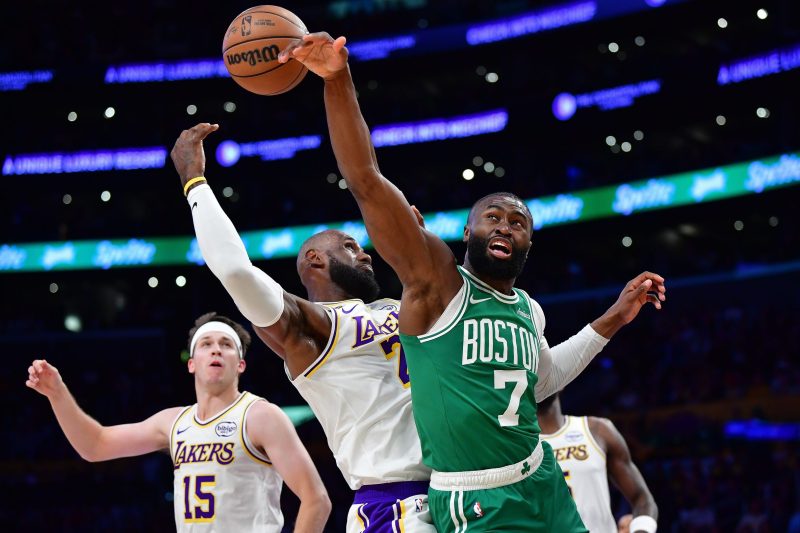
The latest installment of the NBA’s most historic rivalry was staged Sunday, Feb. 22, with Jaylen Brown leading the Boston Celtics to a 111-89 victory over LeBron James and the Los Angeles Lakers on the road.

Brown nearly produced a triple-double, compiling 32 points, eight rebounds and seven assists in 36 minutes of play.

He has taken over as the primary option for Boston since Jayson Tatum tore his right Achilles tendon during Game 4 of the Eastern Conference semifinals on May 12, 2025.

Brown was named the NBA Finals MVP after the Celtics won the championship in 2024, but James believes there’s a case to be made for Brown to be mentioned in this season’s MVP race.

‘This whole MVP thing, I don’t understand why his name is not getting talked about as well,’ James said of Brown after Sunday’s game. ‘Like, nobody gave them a shot to start the season. And he’s averaging what, 30? Just under 30? It’s a popularity contest sometimes, I tell you.’

Brown is averaging 29.2 points, seven rebounds and 4.8 assists per game this season. He’s fourth among NBA players in points per game this season.

The MVP conversation has largely been dominated by Shai Gilgeous-Alexander (Oklahoma City Thunder) and Nikola Jokic (Denver Nuggets), the winners of the prior two MVP awards.

‘It’s an honor to play the Celtics-Lakers rivalry. It’s an honor for LeBron, who’s arguably the best player to ever play the game, to give me some high praise,’ Brown told reporters after the game. ‘So, I’m just grateful.’

James and Brown were teammates during the NBA All-Star Game mini-tournament earlier this month at the Intuit Dome in Inglewood, California.

Who is considered the NBA MVP favorite?

Odds via BetMGM, as of 1 a.m. ET Monday morning:

Shai Gilgeous-Alexander (-140)

Nikola Jokic (+310)

Cade Cunningham (+500)

Victor Wembanyama (+2500)

Luka Doncic (+4000)

Jaylen Brown (+5000)

Donovan Mitchell (+10000)

Anthony Edwards (+15000)

Jalen Brunson (+20000)

This post appeared first on USA TODAY
MILAN — If the headlines and captions look the same and seem redundant, it’s because they are. This happens every Olympic Games now, winter and summer, for the U.S. Olympic team:

‘Girl Power.’

‘The Women’s Olympics.’

‘Team Title IX.’

As the 2026 Winter Olympics have come to a close, for the third consecutive Winter Games, U.S. women have won more gold medals and more medals overall than U.S. men. The final tally here in Milan: American women won six gold medals and 17 medals overall. The U.S. men? Four golds and 12 overall. Two other gold medals and four overall (the U.S. ended up with an historic 12 golds and 33 overall) were in mixed gender events. 

This mirrors what is happening in the much larger Summer Olympics, in which U.S. women have won more golds and more medals than U.S. men for the past four consecutive Summer Games, going back to the 2012 London Olympics. In Paris a year and a half ago, U.S. women won 65% of the 40 gold medals won by Americans (26-13, with one won in a mixed gender event.) And they won 68 medals overall to 52 for the men, with six in mixed events. 

‘It’s always exciting to see the women of Team USA rise to the top of the podium,” U.S. Olympic & Paralympic Committee CEO Sarah Hirshland said in a statement to USA TODAY Sports. ‘In Milano Cortina, they’ve competed with dominant strength and confidence. We’re proud not only of how they perform, but how they represent Team USA off the field of play — especially as veterans mentor rookies and carry forward the values that define the United States Olympic Team at the 2026 Winter Olympics.”

The reason for all the U.S. women’s success? It’s Title IX, the law signed by President Richard Nixon in June 1972 that opened the floodgates for girls and women to play sports and created the mindset of opportunity and participation that dominates American youth, high school and college sports to this day. 

Consider what the U.S. Olympic team would look like without Title IX. Without the law pushing high schools and colleges to add girls’ and women’s sports over the past five decades, there would be very few if any women’s NCAA hockey programs, or soccer, softball, basketball or volleyball for that matter. And without those women’s college teams as the feeder system for the U.S. Olympic team, there would be far fewer medals for the United States at Winter and Summer Olympic Games. And even in those Olympic sports that aren’t traditional college sports, Title IX’s empowering influence on American culture has had a significant impact on all U.S. female athletes.

The world has noticed for quite some time. At the 2012 London Summer Olympics, which was the first time women outnumbered men on the U.S. team and the first time they won more gold and overall medals, British prime minister David Cameron said his country needed to encourage more competitive sports opportunities in schools, just like Title IX in the United States.

With the emergence of U.S. women’s professional sports leagues, allowing athletes to compete and train far beyond their college days, the dominance of American female athletes is all but certain to continue for years to come.

‘These Olympics have showcased the global impact of Title IX more than 50 years after its passing,” women’s sports legend Billie Jean King texted USA TODAY Sports on Sunday. ‘One of the biggest indicators of the power of the legislation is the establishment of professional sports leagues, like the Professional Women’s Hockey League, which provides women athletes opportunities to continue to compete after the Olympics and make a living playing the sport they love. These opportunities in the future are why it is important we continue to protect the legislation and intent of Title IX for all.’

King, who helped provide funding and support for the PWHL, said 61 players from the league competed in the Milan Olympics and 39 were in the gold medal game won in overtime by the United States over Canada.

Another reason more women’s medals are being won is because there are more medals for women to win. There was a time when the International Olympic Committee and the federations of worldwide sports refused to allow women to compete in as many events as men in the Winter and Summer Games. That’s changing; during the 2026 Olympics, the ratio of female to male competitors narrowed to as close to 50-50 as it has ever been in the Winter Games: 47% women, 53% men, according to the IOC. 

The long climb to allow women to compete in events that have been male-only in the Winter Olympics has just a small ways to go now: The only event in which men competed here, but women did not, is Nordic combined.

So give U.S. women opportunities their grandmothers never had, thousands of college teams to play on and professional opportunities that didn’t exist a decade or two or three ago — and they will not be the only ones to benefit. The nation’s Olympic fortunes will too.

USA TODAY Sports columnist Nancy Armour contributed to this report.

This post appeared first on USA TODAY
A government shutdown, big or small, is usually a front-and-center issue for lawmakers — but the most recent partial closure could be put on the back burner as Congress returns to several issues in Washington.

Senate Democrats and the White House are still at odds over funding the Department of Homeland Security (DHS), as the shutdown dragged into its 10th day. Neither side is budging, with the most recent concrete action coming early last week.

Trump, who proved pivotal in striking a funding truce with Senate Minority Leader Chuck Schumer, D-N.Y., in January, was not directly involved in recent negotiations. 

Trump has not had any ‘direct conversations or correspondence’ with congressional Democrats recently, White House press secretary Karoline Leavitt said, noting that the White House and its representatives have been handling the dialogue.

‘But, of course, Democrats are the reason that the Department of Homeland Security is currently shut down,’ she said. ‘They have chosen to act against the American people for political reasons.’ 

Senate Democrats offered a counter to the White House’s own counterproposal, which quickly was rejected as ‘unserious’ by Leavitt. It’s a peculiar instance, given that this is the third shutdown during Trump’s second term, and neither side appears to be in a particular rush to end it.

Senate Majority Leader John Thune, R-S.D., told Fox News Digital that there’s ‘some room for give and take’ in the negotiations, but remained firm in the GOP’s positioning against requiring Immigration and Customs Enforcement (ICE) agents from getting judicial warrants, unmasking or other reforms sought by Democrats that could increase risks for agents in the field.  

‘I felt like, you know, the last offer the White House put out there was a really — it was a good faith one, and it was clear to me that they’re attempting, in every way, to try and land this thing so we can get DHS funded,’ Thune said. 

Funding the agency will be a top priority for the upper chamber, but they’ll be delayed because of winter storms descending on the East Coast. The weather has caused the Senate to delay a vote on the original DHS spending bill until Tuesday night, ahead of Trump’s State of the Union address.

There are other issues that could get in the way of hashing out a deal, including a possible conflict with Iran and Trump’s desire to move ahead with tariffs without congressional approval.

Trump told reporters Friday that he was ‘considering’ a limited military strike against Iran, which already has riled up some in Congress, who are demanding that lawmakers get a say on whether the U.S. strikes.

Sen. Tim Kaine, D-Va., said in a statement that he has a war powers resolution to block an attack on Iran filed and ready, and challenged his colleagues to vote against it.

‘If some of my colleagues support war, then they should have the guts to vote for the war and to be held accountable by their constituents, rather than hiding under their desks,’ Kaine said.

On the heels of the Supreme Court’s ruling to torpedo his sweeping duties, Trump is considering bypassing Congress to move ahead with another set of global 10% tariffs.

That comes as some Republicans are quietly celebrating the end of the duties, and others are open to working with the administration on a path forward for trade policy.

On tariffs, a Republican aide told Fox News that the GOP was ‘waiting to see what POTUS does next.’

‘The State of the Union should be interesting,’ they said.

This post appeared first on FOX NEWS

The 2026 Winter Olympic Games have officially concluded with the closing ceremony following the final event of the world competition in Milan, the gold medal men’s ice hockey game.

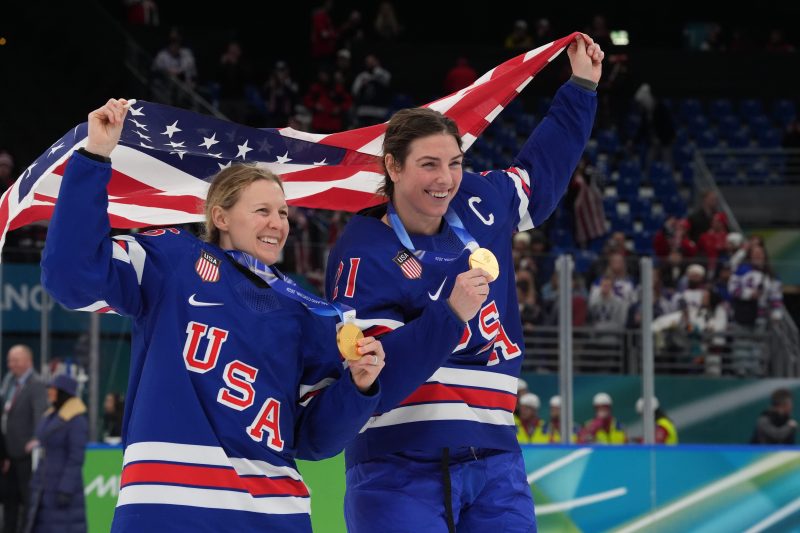
There were many spectacular moments for multiple athletes who competed in the Winter Games, including the men’s and women’s USA hockey teams, each beating Canada to claim the gold medal. The North took home silver.

Countries were able to take home a bragging rights’ worth of medals, but only one could collect the most and that went to Norway.

Individually, there were many high and lows for the world-class Olympians who participated in Milan in 2026. Here are some of the best moments, winners, losers and complete medal count for the 2026 Winter Olympics:

2026 Winter Olympics medal count

Norway led the way with 41 total medals, including 12 golds, the most at the 2026 Winter Games. They added 11 bronze and 12 silver medals, tied for most in the games with United States.

The U.S. came in second overall in medals won with 33 including 12 gold, 12 silver and nine bronze medals.

Italy, host country of the 2026 Winter Olympics, came in third place with 30 total medals and the bronze medals with 14. Italy earned 10 gold and six silver medals.

See the full 2026 Winter Olympics medal count here

Winners and losers

There were high moments for some, and low moments for others. Here are some of the individual winners and loser from the 2026 Winter Olympic Games in Milan.

Winners

  • Megan Keller and the game-sealing goal to help the U.S. national women’s ice hockey team claim its first Olympic gold medal since the 2018 Pyeongchang Games.
  • Laila Edwards became the first Black woman on the U.S. Olympic hockey team, and the first to score during a Feb. 10 shutout against Canada. That was the first time three Black women played in a game with Edwards and Canada forward Sarah Nurse and Canada defender Sophie Jaques. Even better during Black History Month.
  • Jack Hughes clinching the gold medal for Team USA men’s ice hockey with an overtime goal against Canada.
  • Norway’s cross country skier Johannes Høsflot Klæbo won the most gold medals at the 2026 Winter Games with six.
  • Hunter Hess, who took the high road when he could have had some choice words for President Donald Trump, who called Hess a ‘real loser’ on social media.

Losers

  • Canada, it was their second Olympics in a row involved in a cheating this scandal. This time it was Canada’s men’s curling team was under the suspicion of bending the rules.
  • French judges, an Olympic judging controversy potentially cost Madison Chock and Evan Bates an ice dance gold medal. They settled for second, while France won gold. The judges in question, were coincidentally, French.
  • Sturla Holm Laegreid, who admitted to cheating on his former girlfriend. Word of advice, some conversations are better kept private, just saying.
  • International Olympic Committee, Ukrainian skeleton athlete Vladyslav Heraskevych was banned and disqualified for wearing a helmet in tribute to more than 20 fellow athletes and coaches who were killed since Russia’s invasion of Ukraine nearly four ago.

Best moments

These were some of the best moments from the 2026 Winter Olympics.

  • Bobsled Olympian medalist Elana Meyers Tyalor adding to her title of most decorated woman in bobsled history.
  • Breezy Johnson winning gold in Alpine downhill and getting engaged to now-fiancé Connor Watkins who popped the question shortly after her super-G race.
  • Mikaela Shiffrin winning Olympic gold in slalom skiing.
  • Alyssa Liu, repping Oakland, California and the Bay Area as she dazzled her way to a gold medal in her return to figure skating competition.
  • Quad God, Ilia Malinin, and his gala redemption skate to winning gold at the 2026 Winter Games.

Watch Milan Magic: Recap the 2026 Winter Olympics, ranking favorite moments

This post appeared first on USA TODAY