
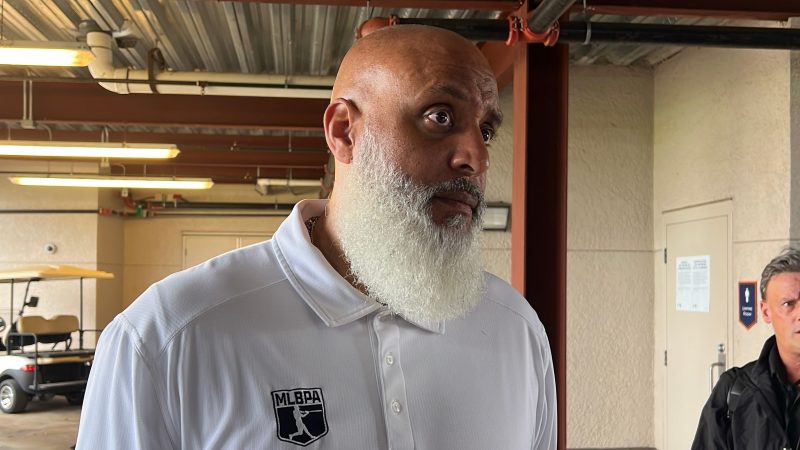
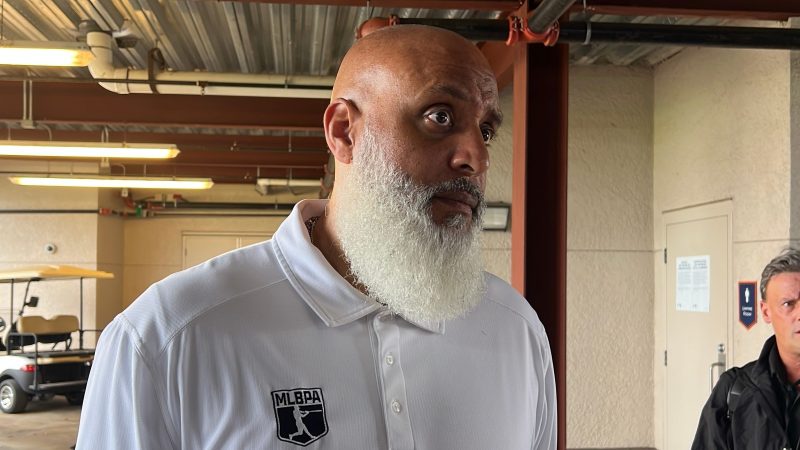
SCOTTSDALE, AZ – The storm clouds are hovering, with the dire forecast of a work stoppage coming a year from now, but Tony Clark, executive director of the Major League Baseball Players Association, refuses to sweat.
He spent four days meeting with players at their executive board meeting this week, with the hottest topic the upcoming collective bargaining agreement. He told them to be fully prepared for a potential work stoppage, but to also ignore the noise that the game will be shut down when the CBA expires Dec. 1, 2026.
“Our interest is getting in the room and hammering out a fair and equitable deal,’’ Clark told USA TODAY Sports and the Associated Press on Thursday. “Our commitment is in the room, at the table and getting to an agreement that is fair and equitable. Other stuff is just noise.’’
Is it possible the game will be shut down and disrupt the 2027 season?
Certainly.
This is why the players voted to have their licensing checks withheld since 2024, which is expected to happen again this year and next.
But will the game definitely be shut down?
No.
“We never go into a negotiation trying to miss games,’’ Clark said. “I can’t speak for the other side, but we don’t go into a negotiation trying to miss games. But in our history, we’ve missed games. We go into a negotiation looking to move the industry forward, protect and advance player rights, as a part of that. We’re going to negotiate in that fashion here.
“But we’re going to be prepared for what the other side is telling us they’re interested in doing. We don’t go into the conversation looking to damage the game, particularly in a world where the game is moving in a very good direction.
“We should be celebrating our guys and the game and what we’re seeing. Our guys are doing that, and they’re performing night in and night out, but the noise is suggesting that the sky is falling. We’ll see once we start formal bargaining what that looks like, but our players are ready for whatever that is going to look like.’’
There’s no need for a union fan council, no need to tell the world that teams are making more money than they let on, and no need to join the chorus and predict a lockout.
Really, Clark and the executive board reiterated, they hear the same complaints of the fans and share the same interests.
The players would love to see greater competitive balance, too, among teams, but don’t believe for a second that a salary cap is the way to accomplish the goal.
While no team shares their financial statements except Atlanta, which is a publicly traded company, the union receives private financial information from Major League Baseball that reveals exactly how much money each team generates in revenues each year.
So, the union is just as frustrated as the fans in some of the small markets who have low payrolls, believing that if they really wanted to compete for a World Series, or simply a division title, they would spend more money on their team instead of pocketing profits.
It will be the primary issue when Major League Baseball and the players union begin their formal negotiations, which is expected to commence in spring training, and was emphasized this week. The last time a small-market team won the World Series was in 2015 with the Kansas City Royals, but the Milwaukee Brewers, who reside in the smallest market in baseball, reached the NLCS this year despite a payroll $300 million less than the Los Angeles Dodgers.
“There are teams who have the wherewithal to compete that are choosing not to … that we don’t believe are putting their best foot forward,’’ Clark said. “Competition is central to what happens in our industry and the excitement that is built around it, much like you’ve seen over the course of the last four or five years. The excitement around it has caused a growth in eyeballs and people with butts in the seats. … But in a world, regardless of whether you’re on the left coast or the East Coast, or whether you’re anywhere in between, and independent of the size of your market, you have the wherewithal to compete.’’
There were strides made in the last CBA that assured that teams aren’t rewarded by consistently losing with the draft lottery and other mechanisms. The Chicago White Sox, who set a modern-day record in 2024 with 121 losses, weren’t eligible to have a draft pick higher than 10th in the following amateur draft.
“Teams were benefiting from losing in a way that incentivized losing,’’ Clark said. “That’s not what we wanted to have. It didn’t quite get as far as we would have liked to in some areas, but we were able to do some things that that changed that value proposition a little, or at least put some uncertainty in the equation whereby just losing the highest number of games doesn’t ensure the No. 1 draft picks.’’
The union made great strides in the last CBA with increased salaries for players not yet eligible for salary arbitration with increased minimum salaries, an incentive program that provided bonuses for player performance, and helping severely curtail service time manipulation with teams being rewarded with a draft pick if their rookies on opening-day rosters won individual awards.
There surely will be modifications and proposed minimum salary increases in this CBA, and at the same time, the players want to see changes in the MLB rule competition committee.
The committee, constructed in 2022, consists of six team owners, four players and one umpire. It was responsible for the introduction of the pitch clock, shift restrictions and the automated ball-strike challenge system that will go into effect in 2026. Yet, no matter how the players voted, MLB had the final say with the six owners all voting in favor of the commissioner’s office recommendation.
“The players have a concern about the well-being of the game,’’ Clark said. “They love it. They’ve dedicated their lives to it, and they recognize the window for them to play it is remarkably small. So they want the game to be the best version of itself.
“When you represent that as a part of the committee, even if you have less votes, and it’s either considered … it tells players that their value, their voice, isn’t being valued. So I remain hopeful, with less votes, will at some point in time yield more substantive responses to the input that players are offering. …. It hasn’t manifested itself the way players had expected.’’
While there isn’t a current player who has been part of a major work stoppage, with many not even born the last time the players went on strike in 1994-1995, Clark reiterated that the players’ solidarity is as strong as ever. When the executive subcommittee voted 8-0 against a proposed CBA deal from the owners in 2022, and the full union membership voted overwhelmingly to instead end the 99-day lockout, Clark called it a sign of strength, not a weakness.
There’s also no need to remind the players to be cautious in publicly addressing a potential work stoppage, believing they are much more media savvy than in 1994-95 when popular players like Tom Glavine and David Cone drew the wrath from fans for their stances.
“It’s different now,’’ Clark said. “These young players are equipped and have functioned in a world that’s much different than the one that we came up. In having said that, you standing on principle, there are always people that are going to challenge your principles. … It’s hard to make everybody happy all the time, but I firmly believe that our players and our fans connect better with our players than they ever have before. They can relate to our guys in ways that they couldn’t, and didn’t relate back then.’’
Now, the hope is that the common goal of competitive balance, when the Milwaukees of the world have the same chance as the Dodgers to play deep into October, can bring everyone together without bringing the game to a halt.
“I will tell you that with some of the issues, particularly as those as they relate to competition,’’ Clark said, “there’s a number of moving pieces in there that can be beneficial to everyone involved, and thus move our game forward.
“We’re looking forward to having those conversations.’’
Follow Nightengale on X: @BNightengale