
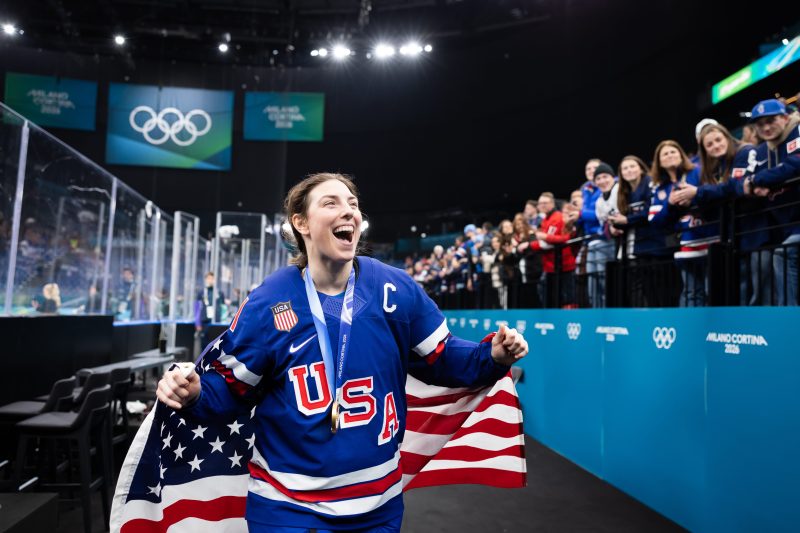
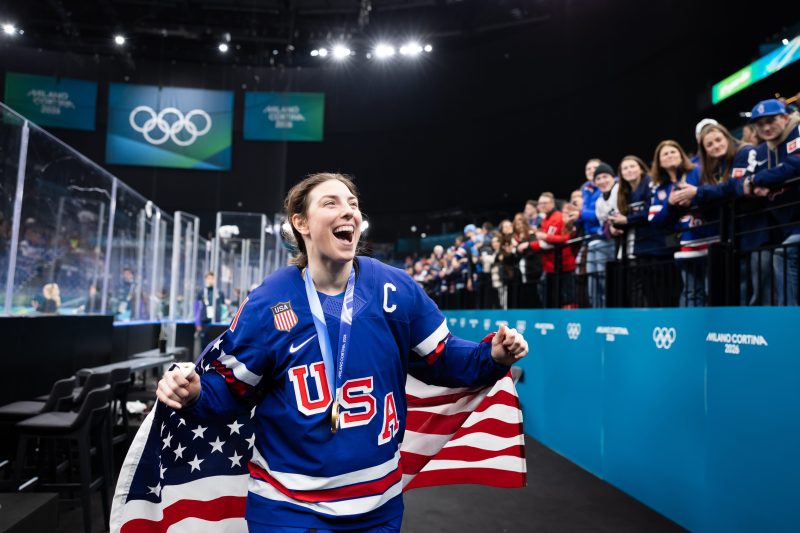
MILAN — After Hilary Knight and the U.S. women’s national hockey team won a gold medal over Canada, the five-time Olympian lifted an American flag over her shoulders in celebration of the overtime win.
The flag that was draped over the shoulders of Knight, widely regarded as one of the greatest hockey players of all time, was procured by the U.S. Olympic & Paralympic Museum and displayed at the Starbucks Winter House, where Knight and the U.S. women’s hockey team celebrated with friends and family early into the morning.
Following the conclusion of the 2026 Winter Olympics in Milan, Knight’s American flag that represents a moment in history will journey over 5,000 miles to its new home at the USOPC Museum in Colorado Springs, Colorado.
‘We love to bring back artifacts right from the Games, so fans can see something they just saw on TV and be able to point that out,’ USOPC museum archival specialist Oriana Va’i told USA TODAY Sports on Sunday.
The USOPC museum hosted its first activation during the Games to raise awareness about the museum, which features countless treasures, including the ‘Miracle on Ice’ scoreboard from Team USA’s hockey upset over the Soviet Union at the 1980 Olympics. The U.S. men’s team went on to become Olympic champions Sunday, defeating Canada in overtime on the 46th anniversary of the iconic upset.
‘It’s set on three seconds. And three seconds is the moment that Al Michaels said, ‘Do you believe in miracles?” said 1988 Olympic figure skating champion Brian Boitano, whose Olympic costume is also on display at the museum.
USOPC Chief Content & Integration Officer Lindsay Flanagan Huban said the exhibition has helped introduce people to the museum. ‘We wanted (athletes) to know that we’re here and happy to be a partner in helping share their legacy,’ she added.
The USOPC museum is home to one of only two complete collections of Olympic torches and gold medals in the world. The other is in Switzerland, meaning the museum has the only set in North America. Huban and Va’i brought three of those torches to Milano Cortina — from 2022 Beijing to mark the last Winter Games, 2024 Paris to mark the last Summer Games and the 1984 Los Angeles torch in honor of the next host of the Games.
‘The Olympic medal display is my favorite,’ Boitano said, adding the torches exhibition is another favorite. ‘The gold medals from pre-war are works of art. They’re all pretty, but it’s kind of fun to go back.’
Medal care kits
Pin trading is extremely popular among athletes in the Olympic village at the 2026 Winter Games, but another hot commodity emerged among U.S. medalists — medal care kits. They are the brainchild of Va’i, who figured athletes would benefit from the same protective equipment at the museum.
‘I (take) artifacts in and out. And when I get medals in that look chipped, dinged or tarnished, I really would like them to be in nice archival boxes to keep them safe just for people to enjoy a hundred years from now,’ Va’i told USA TODAY Sports. ‘So I make medal care kits for the medals we have on display or in our storage, and I figured, why don’t we give them to athletes, directly to them?’
The medal care kits include an acid free box, the same containers ‘used in the museum to take care of artifacts in our collection,’ Huban said.
The box is filled with acid free tissue paper to prevent the medal from tarnishing and has a foam component to safely wrap the lanyard to prevent wrinkles or creases. The kit also provides medalists with white cotton gloves, lint-free wipes to remove smudges and instructions on what to use and what not to use on medals. (‘A little bit of dish soap and some warm water goes a long way,’ Huban said.)
The kits have been wildly popular among athletes. Five-time Olympic gold medalist speed skater Bonnie Blair grabbed one — or five — as did Boitano, the 1988 Olympic figure skating champion, who snagged one while visiting the USOPC museum exhibition at the Starbucks Winter House with USA TODAY Sports.
‘There’s more trouble than athletes ever anticipated with them, too,’ Boitano said. ‘I never thought that. I mean, never. I’ve never taken mine out really, very rarely. And just sit in a safe somewhere, it still has tarnished. I mean, Bonnie (Blair) actually keeps hers in her pocket. … So literally at a dinner party, she’ll be like, ‘Have you seen my gold medal?’ It’s like she’ll pull it out. Literally, she had probably hundreds of people touch it here.’
Word of the medal care kits even got back to the 1998 women’s hockey team that won gold in the inaugural women’s competition: A member of the squad grabbed one and ‘forwarded the message to her whole team in their group chat. And we’ve heard from four different members of the team saying, I want one,’ Huban said.
‘It’s nice to see (athletes) actually using them here,’ Va’i added.
Procuring artifacts
One of the most important additions to the medal care kit is a card with contact information for athletes that want to be memorialized in the museum by loaning or donating Olympic or Paralympic memorabilia. It’s one of two ways the USOPC museum procures artifacts.
‘Chris Mazdzer, a luge athlete, reached out and said, ‘Hey, the luge gloves that you have on display are from the seventies. They don’t look like that anymore. Do you want mine instead?’ And I said, ‘Yes, please, that would be lovely,’ ‘ Huban recalled. ‘So he sent us two pairs. So one is on display and one is actually on a demonstration card so people can pick it up and touch them, and they have spikes on the fingertips.’
Athletes reaching out is one way. The USOPC museum making first contact is another.
‘We’ll come up with an exhibit idea and then decide what are the best stories that we need to tell to support this exhibit, and how do we source the artifacts to support those stories?’ Huban said. ‘And we say, ‘Hey, we would like to feature you in an exhibit. Can we borrow something to put on display?”
Boitano said it’s amazing to know the costume he wore to win Olympic gold is in proper hands: ‘Our costumes are made out of spandex, and spandex doesn’t age very well. So it’s great to know that it’s being taken care of.’
Huban said building trust and connections with athletes is another goal of the Winter House exhibition to help the museum collect pieces for future exhibits. She added, ‘We want to support the athletes and support Team USA.’
Reach Cydney Henderson, USA Today’s National Women’s Sports Reporter, at chenderson@gannett.com and follow her on X at@CydHenderson.