
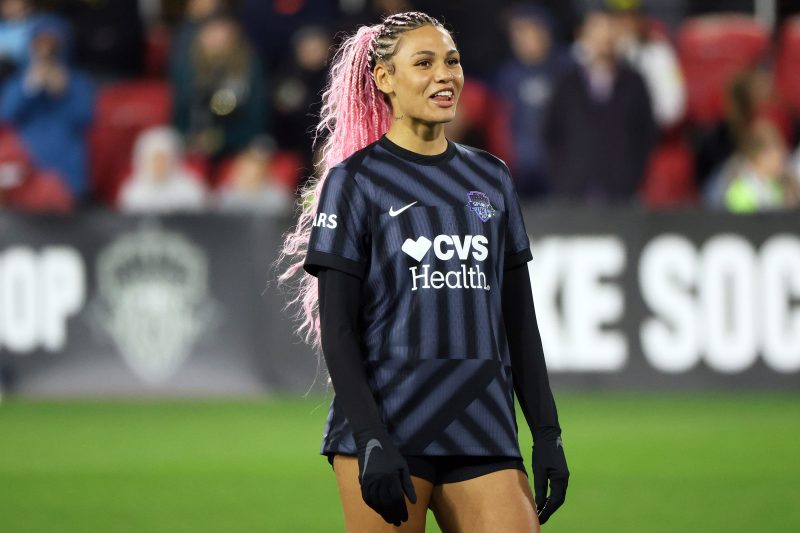
Soccer phenom Trinity Rodman slept in until 1:30 p.m. on Wednesday.
‘I was supposed to hang out with my family, and they knew not to call me,’ she said at NWSL media day. ‘I didn’t leave my bed, didn’t take my bonnet off.’
It was a much needed reset for the Washington Spirit star after a whirlwind of an offseason. Other than scoring two goals with the United States Women’s National Team in the last week, Rodman has been at the center of arguably the biggest contract dispute in women’s sports that reached its end last week. Rodman signed a new deal with the Spirit reportedly worth more than $1 million a year through 2028, making her the highest-paid player in league history and women’s player in the world.
‘I couldn’t even really imagine leaving,’ Rodman told USA TODAY Sports. ‘Not even just my house, the fans in the stadium. I can’t imagine a different feeling than what you get in DC. It’s just like every match day, you’re just so excited to interact and feel that from the crowd. And it’s not even just game day. It’s game day with them.’
Rodman — a free agent after her contract with the Spirit expired at the end of 2025 — originally agreed to terms with the club on a multi-million dollar contract in December, but NWSL commissioner Jessica Berman vetoed the deal because she believed it ‘violated the spirt of the league.’ The NWSL Players Association filed a grievance on Rodman’s behalf.
Meanwhile, Rodman was reportedly receiving interest from several European clubs just months after other high-profile NWSL stars such as Alyssa Thompson and Naomi Girma left for million-dollar transfers overseas. The NWSL’s response to try and keep their top talent came in the form of the high impact player rule, which allowed clubs to exceed the league’s salary cap by up to $1 million for players that met the following criteria:
- Player is on SportsPro Media Top 150 Most Marketable Athletes within the one year prior to the current league season; or,
- Player is selected in the Top 30 in Ballon d’Or voting in the two years prior to the current league season; or
- Player is selected in the Top 40 of the Guardian Top 100 football players in the world in the two years prior; or
- Player is selected in the Top 40 of ESPN FC Top 50 football players in the world in the two years prior; or
- Top 11 minutes played for the USWNT in the prior two calendar years for field players for all competition types; or
- Top one minutes played for USWNT in the prior two calendar years for goalkeepers for all competition types; or
- Player selected as NWSL MVP Finalist within previous the two league seasons; or
- Player selected to the End of Year NWSL Best XI First Team within the previous two league seasons.
The rule quickly came under fire for its restrictive criteria. USWNT head coach Emma Hayes said she had no knowledge of the deal until it was announced. The NWSLPA filed a lawsuit a month later, saying the league violated federal labor law and the collective bargaining agreement by unilaterally implementing the salary change and calling for the ‘immediate rescission of the HIP rule.’
As an alternative solution, the union proposed the league could raise the salary cap, which would not have violated the terms of the CBA.
But for all the controversy, the players at media day seemed to overwhelmingly be in favor of the rule.
‘It’s great that that happened,’ Mallory Swanson, Rodman’s USWNT teammate, said. ‘That’s changing the game.’
Swanson said she isn’t fully caught up on the rule itself due to caring for her newborn child, but was mainly expressing support for Rodman.
Angel City FC right back Gisele Thompson, whose sister Alyssa signed a record-breaking $1.3 million transfer with Chelsea last September, said the HIP rule is a good starting point for the direction the league and sport need to go in.
‘This is obviously a start to the growth of women’s soccer and how we should be paid,’ she told USA TODAY Sports. ‘This shouldn’t even be a problem. Like, I think Trinity deserves to be paid more. Yeah, that is a lot of money, but she deserves more than that, and I know a lot of players do as well.’
Forward Ivonne Chacón started her career in her home country of Colombia before making the move to Spain’s Liga F, where she played for Valencia and Levantes UD before transferring to San Diego Wave FC last summer. In recalling her journey, Chacón told USA TODAY Sports she was attracted to the NWSL because she wanted to play against the best. Everything, from the professionalism of the players to the fan support, was top-tier.
With the implementation of the HIP rule, Chacón sees an opportunity for the NWSL to not just retain its top talent, but to attract more of it.
‘That has a worldwide impact,’ Chacón said in Spanish. ‘It makes the top players want to come to this league, and honestly it’s little compared to what we really deserve. I feel like women’s football should pay the players significantly more. But it’s great that the league has these kind of contracts and inspires players to come to the league.’
Mia Fishel was drafted fifth overall by the Orlando Pride in the 2021 NWSL draft. One month later however, Fishel instead signed with Tigres UANL of Liga MX Femenil in a sharp rejection of the NWSL’s draft system. She went on to play at Tigres for two years and helped her club win the 2022 Apertura in her first season. She transferred to Chelsea in 2023 and spent two more years in the Women’s Super League before signing with Seattle Reign FC last summer.
Fishel told USA TODAY Sports she believes the HIP rule is the best way for the NWSL to keep up with big-spending European leagues like the WSL, which has no salary cap and therefore, no limits.
‘We all want what we deserve,’ she said. ‘… I’m happy that (Rodman’s) team and her put it out to the public and are pushing the envelope of like, ‘Hey, this what we deserve, this is the future,’ and continue to push that. I think it’s huge.
‘It’s amazing. I’m glad that it happened.’
At the outset of the whole saga, Rodman did expect some things to turn out the way they did. For her, it was a necessary and inevitable part of growing the game.
‘Ultimately, the goal is to get as much as you can, or get what you’re worth,’ Rodman said. ‘And for me to toot my own horn, I do feel like I bring a lot to the league. There’s obviously a lot I need to improve on, and on the field I can be so much better year to year, but I think it’s the off the field stuff that brings so much to the league. And I think we’re growing that, and you’re seeing that.’
The HIP rule has flaws. But in it, players see a glimmer of the progress they’ve been pushing for, and the players before them pushed for, for decades.
‘I’m hoping that that impact is kind of what is carrying the weight of all of this, rather than it just being like, ‘OK, she’s a fun player. She got paid a lot,” Rodman said. ‘I want it to hold more than that, and I hope it does and continues to.’