
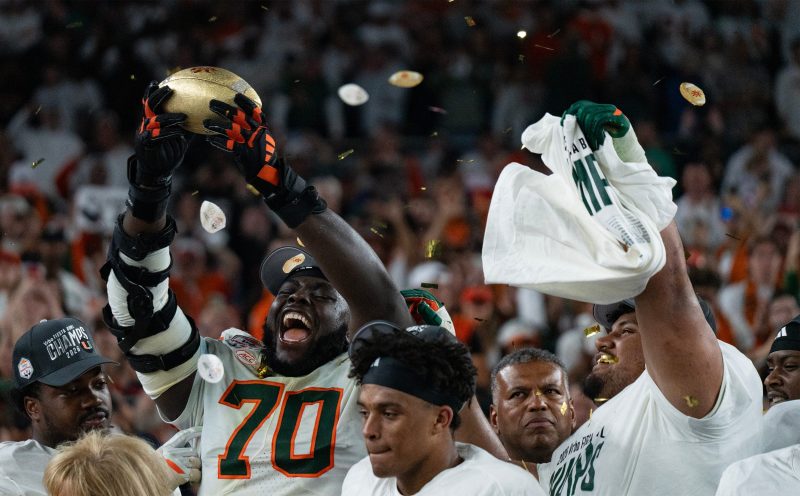

GLENDALE, AZ — There was some strange symmetry to it all, a torch passing no one saw coming.
Miami, everyone, is built and playing like an SEC team.
The SEC, meanwhile, just polished off a postseason where it lost a conference-record eight games against other conferences.
“We line up, and we want to punish you on offense and defense,” said Miami defensive end Akheem Mesidor. “You’re going to have to play your absolute best game to beat us.”
Well, well. Now who does that sound like?
Here’s a hint: the bully on the block that has fallen, and can’t seem to figure out why or how to get back up.
From dominating college football with 14 national titles since 2003, to the fateful irony of the SEC brought back to the pack by its own greed.
The SEC wanted Texas and Oklahoma, wanted to drastically change the conference footprint of the sport, and then sat and watched while the Big Ten panicked and did the same, while the Pac-12 was eaten and eliminated (it ain’t the same now, people), and while the Big 12 and ACC were relegated to second citizens.
The SEC, along with the Big Ten, then grabbed control of the postseason and threatened to take their ball and go home unless everyone fell in line. They want more access to the postseason, and they’ll surely receive the lion’s share of revenue from what could be a near $2 billion annually expanded College Football Playoff. Like it or not.
They wanted unregulated NIL and free player movement, or at the very least, did next to nothing to stop it. They, along with every other FBS university, knew for 16 months that states of California and Florida had passed bills that would become law in June of 2021 — and did nothing about it.
They punted, and begged Congress for help. Imagine that, two self-interested and wildly dysfunctional entities trying to figure out a massively complex financial and structural problem.
What could go wrong?
The bigger question is, what did they think the rest of college football would do? Certainly not sit and take it.
There are millionaires and billionaires who love their universities and are obsessive about winning. Throw open the doors to NIL and free player movement — and legalized big booster involvement — and watch how quickly the SEC looks like the ACC.
Watch how quickly Alabama comes back to the pack, and Georgia can’t get out of the quarterfinals in the CFP. How quickly LSU and Florida and Texas A&M spend hundreds of millions of dollars to fire coaches and start over.
More to the point, watch how quickly the deep-pocket Cody Campbells of the world begin to simply play by the rules laid out by the SEC and Big Ten ― and build teams that look and play like SEC teams of the past.
Want to know why Texas Tech won the Big 12 for the first time in school history, and won a school-record 12 games? It had one of the best defensive lines in the nation, and a Top 5 scoring defense.
Want to know how Miami has finally found itself again after more than two decades of stumbling around like NC State? The Canes have the best defensive line in the nation, with two edge rushers who will be Top 15 NFL Draft picks.
Remember all of those nasty and dominating defensive lines at Alabama and Georgia, all of those NFL draft picks? Nothing defined SEC dominance, SEC national titles, quite like physical, game-changing defensive linemen.
Now they’re leaving high school and/or the transfer portal for the highest bidder. The idea of playing for the SEC, while certainly tempting, is quickly trumped by another zero at the end of a paycheck.
“More options for players, that’s the big thing,” said Miami safety Keionte Scott. “If it’s not working for whatever reason at another place, there are options.”
It wasn’t working for Scott at Auburn, which hasn’t found an answer since firing Gus Malzahn after the 2020 season. So Scott became one of six transfer starters on Miami’s defense — including the entire secondary — and is now a game away from a national championship.
Meanwhile, the SEC hasn’t looked further away from winning it all ― having gone three straight seasons without playing in the national championship game for the first time since 2000-2002.
Go ahead and expand the CFP to 16 or 20 or 24 teams. Go ahead and continue to declare players don’t want to be employees, and avoid the one thing that could deliver some semblance of control to a player procurement process with no guardrails — just because you don’t want to share more money when collectively bargaining.
And Indiana, with the largest alumni base in college football, will continue to spend its way out of the NCAA cellar. Will beat Georgia to sign Heisman Trophy-winning quarterback Fernando Mendoza.
Miami, with its deep pocket boosters begging for a return to glory, will do the same.
So will Texas Tech and Utah and BYU and SMU and … see where this is headed?
Right to the end of SEC dominance.