

- The Buffalo Bills’ new stadium will feature a natural grass playing surface, a change from the artificial turf they have used since 1973.
- Despite higher maintenance costs, the team chose grass for player health and career longevity, a decision championed by co-owner Kim Pegula.
- Modern technology, including an underground heating system and grow lights, will be used to maintain the grass in Buffalo’s cold climate.
- Players like Dion Dawkins and A.J. Epenesa support the move, citing less body ache and wear-and-tear compared to playing on artificial turf.
Grass in. Turf out.
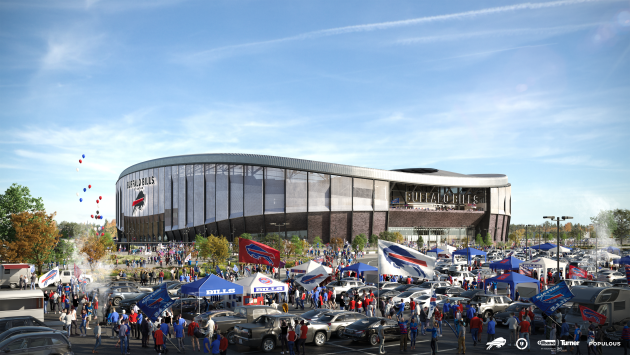
Of all the high-tech bells and whistles that will come with the Buffalo Bills’ new home when they move into a new Highmark Stadium later this year, a distinctive old-school feature will provide a signature centerpiece for the $2.2 billion facility: The franchise has opted for a playing surface of natural grass.
Never mind the cold and snow that come with challenging Buffalo winters. The Bills, leaning on modern technology, are gearing up to make a statement that will raise the bar in the NFL’s grass vs. turf debate.
They’ve come a long way since “The Rockpile” – the derisive nickname for dilapidated War Memorial Stadium – where the Bills played before moving to suburban Orchard Park in 1973. The team has played home games on artificial turf since then.
“Buffalo, it’s not 1973 anymore,” Bills general manager Brandon Beane told USA TODAY Sports, alluding to features at the new stadium that include a heating system as part of the underground infrastructure and grow lights to be used to help maintain grass at the outdoor venue.
“We’re in 2025. You’ve seen places like Green Bay, Pittsburgh, Kansas City and Chicago using technology; that helped us put together a plan to be able to handle the weather here. We feel we have the right grass people and field turf people to help us manage this. And our players are going to benefit from playing on grass.”
It’s a bold move, particularly striking as NFL players overwhelmingly express desires to play on natural grass while the league points to data that it says suggests there’s no significant increase to injury risk from playing on artificial turf rather than grass.
“The turfs have improved,” Beane said. “No doubt, the stats have improved on artificial turf. But you’re never going to convince me that something’s better than the real grass.”
‘Player-centric’ approach led to Bills’ choice of grass at new stadium
Fifteen of the NFL’s venues have grass or grass-hybrid playing surfaces, including several with colder winters, such as Denver and Philadelphia, in addition to the four that Beane mentioned.
Despite higher costs over the long run for going grass rather than turf, Beane said the franchise led by co-owners Terry and Kim Pegula, is driven by a “player-centric” motivation.
According to Sportico, the cost of a new grass field ranges from $300,000 to $500,000, with annual infrastructure costs that can add $1 million. Artificial turf, according to Sportico, costs between $1 million and $2 million to install, but requires less maintenance and has longer shelf life.
Beane pointed to Kim Pegula as a key force in the team’s decision, dating to 2018, shortly after the GM and coach Sean McDermott arrived the previous year.
“She was really behind, ‘How can we help our players thrive here and extend their careers?’ ” Beane recalled.
After forming a committee charged to update the team’s headquarters, Beane said the idea of replacing the turf at the existing Highmark Stadium was considered but put on hold as the owners sought what turned out to be the taxpayer-supported new stadium.
“I think that’s going to be a light on some guys, for sure,” Bills edge rusher A.J. Epenesa told USA TODAY Sports.
Epenesa, a sixth-year veteran, figures older players will feel more benefit due to wear-and-tear endured over a longer period. Yet he admits he enjoys practicing on the grass fields the team often uses. The artificial turf, he described, “It’s literally just a slab of concrete with some green grass and those black pellets on top of it.”
“Super, super achy, bro,” Dawkins told USA TODAY Sports. “You can drastically tell the difference.”
Count Dawkins in the number hoping that Buffalo’s decision on a grass field will inspire other NFL powerbrokers to follow suit. Sure, that’s a longshot. But, well…
“We’ll just add to the positivity of the NFL,” Dawkins said. “Let’s check this one off and shoot for the other teams to make sure they have grass as well. I know there are several already, but we want those numbers to outweigh the turf number.”
‘They love cold and they love snow.’ Bills’ grounds crew embraces new challenge
John Sorochan, the NFL Players Association’s field consultant, is bullish on the prospects for the Bills. He said the Bills will use Kentucky bluegrass, the type that the Packers, Broncos and Steelers use, currently being grown at a sod farm in New Jersey.
“The two groundsmen that they have are true Buffalo people,” Sorochan told USA TODAY Sports, referring to Aaron Ramella, the Bills director of grounds, and Chad Laurie, assistant director of grounds.
“They love cold and they love snow. They are good turf managers who know to ask questions. And they’re excited for the new challenge, for sure.”
Sorochan said the design of the new stadium, with a roof that will cover the stands, will lessen the burden on the grounds crew in one regard: Snow removal. The roof is heated, which will melt snow.
“They can do different things when blizzards hit,” Sorochan said. “Snow removal won’t be like now, where they push snow from the stands to the field, then remove it. It will be a new deal. Snow won’t be in the stands, so the grounds crew can just focus on getting the field ready.”
The grass field. Which will be some sort of new deal – in Buffalo, of all places.
Contact Jarrett Bell at jbell@usatoday.com or follow on X: @JarrettBell